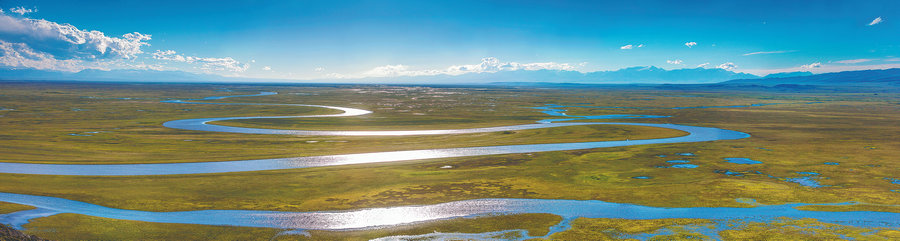
Bayanbulak Grassland
Overview
Bayanbulak Grassland is a stunning natural expanse located in the Xinjiang Uygur autonomous region of China, nestled within the Tianshan Mountains. Known for its picturesque landscapes, the grassland is often described as an emerald surrounded by diamonds due to its verdant fields and the snowy peaks that encircle it. The name "Bayanbulak" translates to "abundant spring water" in Mongolian, aptly reflecting its rich water sources, including a river that winds through the area, branching into numerous tributaries.
Geographic and Environmental Significance
Situated at an altitude of approximately 2,500 meters, Bayanbulak Grassland spans roughly 137,000 hectares. This region is characterized by its cold climate, with an average annual temperature around -4.7°C. The winters are particularly harsh, with temperatures capable of plummeting to -48°C, while July offers a respite with warmer temperatures that can reach 28°C, providing ideal conditions for the local wildlife to thrive.
The grassland is primarily nourished by meltwater from the surrounding snowcapped mountains, contributing to its lush greenery and biodiversity. The Kaidu River, one of the significant water bodies in the area, creates a network of wetlands that serve as a habitat for a variety of species.
Swan Reserve
Bayanbulak Grassland plays a crucial role as a breeding ground for the whooper swan (Cygnus cygnus), one of the three swan species found in China, alongside the mute swan (Cygnus olor) and the tundra swan (Cygnus columbianus). While the latter two species typically spend only the winter months in China, the whooper swans use Bayanbulak Grassland for nesting.
Every year, from mid-March to September, the reserve becomes a sanctuary for these migratory birds as they flock to the wetlands for nesting and rearing their young. The presence of abundant food sources such as weeds and plankton supports their stay, allowing them to build strength for their subsequent migration.
Conservation Efforts
Bayanbulak Grassland was established officially as a national reserve in 1986, marking a significant step in the preservation of its unique ecology. Since then, it has gained both national and international recognition, including being part of the UNESCO World Heritage-listed Xinjiang Tianshan since 2013.
Conservation efforts are spearheaded by the reserve's administrative bureau, which has established a management station staffed with full-time custodians and additional recruits during peak seasons. These wardens are responsible for monitoring swan behavior, preventing disturbances, and ensuring the protection of both the swans and other wildlife in the reserve.
The swans are closely monitored, especially those unable to migrate due to lack of strength. For these swans, food provisions such as corn seeds are distributed regularly to sustain them through the harsh winter months.
Cultural and Ecotourism Potential
Bayanbulak Grassland is not only a haven for wildlife but also a cultural treasure within the Xinjiang Uygur autonomous region. The region is home to diverse ethnic groups and cultures, adding a rich cultural dimension to its natural beauty.
Recent improvements in infrastructure have enhanced access to the grassland, boosting its potential as an ecotourism destination. Visitors can explore the breathtaking scenery, observe the swans in their natural habitat, and experience the unique cultural tapestry of the region. This harmonious blend of nature and culture makes Bayanbulak Grassland an attractive destination for sustainable tourism, offering economic benefits while preserving its ecological integrity.
Challenges and Future Prospects
Despite the advancement in conservation and tourism, Bayanbulak Grassland faces ongoing challenges. The harsh climate and remote location pose difficulties for conservationists and researchers working to protect the area. Additionally, balancing the growth of tourism with ecological preservation requires careful management to ensure that the natural habitat remains undisturbed. Article reference1. Land of the rising swan. chinadaily.com.cn. 2022Photo Gallery(2 pictures)CategoriesTourismTagNatural WonderCatalogue1. Overview2. Geographic and Environmental Significance3. Swan Reserve4. Conservation Efforts5. Cultural and Ecotourism Potential6. Challenges and Future Prospects- - - []








